There is an old occult maxim which declares that—" Nothing is concealed from him who knows." No Mason is bound to conceal that which he has never learned in the Lodge. All else he receives as he learns any thing, places his own estimate upon its value, and becomes individually responsible for its use. It must be a matter of conscience, and be weighed in the balance of duty, and every one must abide by the result. If Masonry has lost the Royal Secret, or if it never possessed it, or if it was wrenched away in the very name of Religion little more than a century ago, all the same, it belongs to the Craft as the Heir-apparent of the Old Wisdom. But the time has come when no cable-tow can bind it. It now belongs to Humanity equally with the Mason. To this end has it been preserved throughout the centuries.


Showing posts with label Mandala. Show all posts

Friday, January 4, 2013

Buddhism and Freemasonry - Seeking Harmony


Over the years I have been contacted by various individuals as to the compatibility of Buddhist thought and its seemingly non-theist philosophy to that of Freemasonry, two seemingly opposite traditions that when looked at closely are more similar than most could imagine. 
This seemingly opposite philosophy, Buddhism, is something I have addressed in the past and surely will again in the future has to do at it's core the western concept of 'God', a 'God' the Buddha spoke nothing of, and even if he had it would not of been the Judaic concept of Deity, a problem for some brothers that believe Freemasons must believe in a 'personified' Judaic god, a mistake I believe that has caused the Tradition of Freemasonry a great many exceptional candidates. It should be noted that even as I write this in the State of Florida the Grand Master has sent out an edict banning certain individuals because of their seeming different belief systems from what he perceives Freemasons should adhere, a slippery slope indeed. 
But we'll save that discussion for another time, for now let's look at a little harmony and avoid division.
Allow me to share an interesting passage from 'The influence of Buddhism on primitive Christianity' by Arthur Lillie, 1883 (written during a time when Freemasons still explored alternative philosophies).
"In modern Masonry it is feigned that Hiram Abiff, the architect of Solomon's temple, made three efforts to escape from three assassins. These are plainly Old Age, Disease and Death."

For those unfamiliar with the ritual story played out in Freemasonry Hiram Abiff is the name of the persona each and every mason assumes as he proceeds through the degrees (series of progressive rituals), he is symbolic of every man.  
All Buddhists have heard the story of the Buddha and what some call 'The Four Sights', the cause of the Buddha's search, for those Masonic brothers unfamiliar with the story of the Buddha allow me to share a lite version: when Prince Siddhartha (the Buddha to be) was a few days old, a holy man prophesied the Prince would be either a great military conqueror or a great spiritual teacher. His father, King Suddhodana, preferring the first outcome prepared his son accordingly, a conqueror he should be. The wise king at the same time fearing the Prince could become a holy man attempted to cover his butt by raising the boy in great luxury and opulence shielding him from knowledge of religion and human suffering, a futile attempt. 
The Prince reached the age of 29 with little experience of the world outside the walls of his opulent palaces.
One day, overcome with curiosity, Prince Siddhartha asked a charioteer to take him on a series of rides through the countryside. On these journeys he was shocked by the sight of an aged man, then a sick man, and then a corpse. The stark realities of old age, disease, and death seized and sickened the Prince.
Finally, he saw a wandering ascetic. The charioteer explained that the ascetic was one who had renounced the world and sought release from fear of death and suffering (you could say he was searching for light, the quest of all Freemasons). The future Buddha's heart was stirred.

Question the candidate for Freemasonry is asked in the first ritual: Where were you first prepared to be made a Mason? The answer: In my heart.

"The way is not in the sky. The way is in the heart."...Buddha

Now let's look at another passage of Arthur Lillie's 'The influence of Buddhism on Primitive Christianity': "(speaking of Hiram Abiff the author writes) he sought to evade the first (assassin) at the east of the temple, in the same way that Buddha tried to escape by the eastern gate. The second and third flights of Hiram and Buddha were to the same points of the compass. Then Buddha escaped the lower life through the Gate of Benediction, and Hiram was killed."
What are these gates Arthur Lillie is talking about and where could they be alluded to in Freemasonry?
In the design of the Masonic Lodge Room we find these cardinal points of the compass emphasized with the chairs of the Lodge officers, except the north, the darkest portion of the sky. It's only fitting that the Buddha end his journey in the north, according to Buddhist philosophy after enlightenment the Buddha is no longer stuck in the cyclic existence, birth, old age, sickness, and death.
We can clearly see the path of the future Buddha alluded to through the symbolism of the gates. The east, also symbolic of spring, is the beginning of the Buddha's journey, the south gate represents the summer, the west fall, and the north winter the end of the Buddha's journey.
This same journey is played out in Freemasonry, albeit with a different ending, yet maybe passing on the same message.
In Freemasonry we find the candidate progressing through the gates, east, south to west, only to loose his life to be reborn into the 'light'. As you can see a similar journey, a similar outcome,
the Buddha achieves 'enlightenment', the Freemason seeks 'light', coincidence in the vernacular? I think not.

"I am the gate; whoever enters through me will be saved. He will come in and go out, and find pasture."...John 10:9

Just a little note for those interested in Buddhist philosophy, Buddhism teaches that there is a cycle of birth, death, and rebirth and that the process is according to the qualities of a person's actions. This constant process of becoming ceases at the fruition of 'enlightenment' at which a being is no longer subject to causation, karma, but enters into a state that the Buddha called amata, deathlessness.
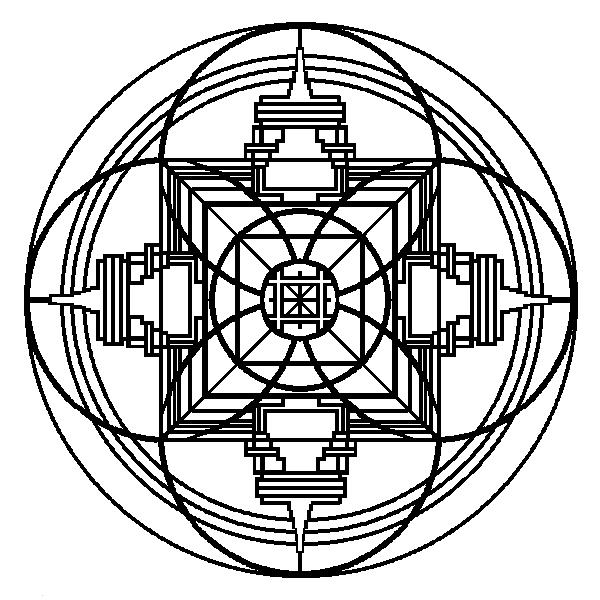
MANDALA
Spend a little time brother contemplating the Mandala above, you just may find the similarities yourself.

Those who have followed my blog know that I strongly believe the Masonic Lodge Room symbolic of Mandala, a Sanskrit word that means "circle". Yes I realize our Lodge Rooms are really rectangle in design, but our rituals are done in a circular fashion, and the center of the Lodge Room is also considered to be the symbolic point within the circle. 
In the Hindu and Buddhist religious traditions their sacred art, shrines, and temples are often mandala in form. At the center of most Hindu and Buddhist mandalas we find a 'square' with four gates containing a circle with a center point, no different than the basic layout of the Masonic Lodge Room.
In the Masonic Lodge Room we find these gates spoken of as north, south, east, and west, similar to the directions used in the Buddhist Mandala. 
Mandalas are constructed from the center outward, beginning with a dot in the center, very much the same way the initiate in Freemasonry begins his journey from the center of the Lodge outward.  
With the placement of the center dot, the Mandala is consecrated to a particular deity. In the case of the Masonic Lodge Room we usually find the Scared Volume of Law at the center symbolic of the deity of one's choice. This center in Buddhism is a symbol. it means a 'seed', 'sperm', 'drop', the salient starting point. It is the gathering center in which the outside energies are drawn and, in the act of drawing the forces, the devotee's own energies unfold and are also drawn. Thus it represents the outer and inner spaces. Its purpose is to remove the object-subject dichotomy (our typical dualistic view of life).
In its creation, a line materializes out of a dot. Other lines are drawn until they intersect, creating triangular geometrical patterns. The outlying square symbolizes the physical world moving in four directions, as we have seen represented by the four gates.

Mandalas are seen as sacred places that reminds us of the presence of sanctity in the universe and their own potential. In the context of Buddhism, the purpose of a Mandala is to put an end to human suffering, to attain enlightenment and to attain a correct view of Reality. It is a means to discover divinity by the realization that it resides within one's own self, no different than the goal of the initiate in Freemasonry.
If you would like to see a little more comparison between the mandala and the Masonic Lodge Room check out my previous blog 'Welcome to the Mandala of Freemasonry'.

Friday, August 12, 2011

Introduction to Old School Freemasonry - Part One

First I would like to apologize, it may seem I have been behind on my “Purposely Hoodwinked” blog, but I assure you I have writing away.
To date, the current post you have in front of you is already 7228 words long, and still going, not all of which I will present today.
As one who does not always understand the decreasing sentence structure, tweets, and mini abbreviated Facebook entries, I do realize that the fact is no one will read a blog entree that is over twenty pages long, to date, so I’ve decided to divide it into chapters, thereby satisfying those that can only stand small, quick, and hopefully concise blog entrees.
It has never been my desire to be an author, and it still isn’t, I began this blog to share insight into what many would call “esoteric” Freemasonry, a subject I have found few within the fraternity was even familiar with.

Although Freemasonry is not a business allow me to share a little insight as a business owner.
Many fear Freemasonry is slowly becoming a historical memory, membership is down, and some would say dying day by day. If this decline was occurring in my business, or in any business that desires to succeed, the business itself would have to take a critical look situation, just having “Open Houses” hoping for new members is not the answer unless we clearly have an idea of business is. We still haven’t looked deep into the decline.
I can hear certain brothers blaming the television, the computer, the downfall of fraternal organizations, and the lack of community; all those could be valid, to a point.
Much of what I am going to present may seem critical at times to the Fraternity, to which I so proudly belong, but this respectful criticism should not be taken to be demeaning, it’s meant to be enlightening. Only by looking at ourselves, deeply, are we able to “Know thyself”, the same follows with Freemasonry.
The approach I am taking is to allow the deeper aspects of Masonic symbolism to open up the purpose, intent, and goal of Masonic thought. To prove beyond a shadow of doubt that Freemasonry is much more than a fraternal organization, which it seems to have found itself?

With that said I offer here a sort of introduction to what will follow:
Over and over as I search the web for enlightened symbolic thought and all I find is confusion and often times down right ignorance, a common malady of those stuck in what I call the “lowest common denominator’ of symbolic interpretation.
What I would like to do, for the benefit of those that have a serious interest in esoteric symbolism, is show you a different view, a way of seeing above the norm.
As an initiate of what is labeled a western ancient mystery school Freemasonry, I will be using some of the symbols of my tradition to aid you in unlocking that “lowest common denominator” mindset, thus allowing you to see at a level above the rarely discussed levels in the western esoteric traditions.
Don’t think for a moment you need to belong to one of the mystery traditions to understand what I am about to put forth, if truth be told once you consider the material presented you’ll probably know more then most initiated into many of the various mystery schools, including Freemasonry.
Although mystery schools have been around for centuries you would be surprised just how few even know of there existence, or function, including sadly some within the mysteries themselves.
If one looks carefully at the definition in context to the ancient mystery school the term "Mystery" derives from Latin mysterium, from Greek mysterion (usually as the plural mysteria μυστήρια), in this context meaning "secret rite or doctrine." An individual who followed such a "Mystery" was a mystes (a mystic) "one who has been initiated," from myein "to close, shut," a reference to secrecy (closure of "the eyes and mouth") or that only initiates were allowed to observe and participate in rituals. The fact is there is nothing nefarious about the mystery school path, in fact if one was to look close at the many spiritual traditions I’m sure you’ll find initiate, ritual, and symbolism in the forefront of progression in that tradition.
Take for instance the Kalachakra Mandala of Buddhism, once a very secret initiation performed by chosen monks is now performed openly for the benefit of all sentient beings and world peace. Many spiritual aspirants are now familiar with the traveling monks who perform the Kalachakra Initiation generally given over 12 days. First, there are eight days of preparation rituals, during which the monks make the mandala. Then the students are initiated, after which they are allowed to see the completed sand mandala. The ceremony ends when the monks release the positive energy of the mandala into the everyday world through a final ritual. Once this centuries old initiation was performed only under the most secret conditions, not seen by those outside the order, but is now performed openly for our benefit.
For those unfamiliar with the mandala I assure you as you continue on a surprise awaits one that should be of serious interest to those especially initiated in the Masonic tradition and interested in Unity.

What I will present here is some of the teachings of the mystery school.
For those that have not been initiated and wonder of the importance of initiation and what initiation has to offer, in a simplified way of explaining the psychological process that takes place during initiation or ritual it is that on a personal level the initiation or ritual it is becoming part of you, it enters your subconscious where hopefully an unfolding takes place. Take for instance, in many Christian traditions the Ritual of the Eucharist, a ritual where the participants are told they are partaking symbolically of the body of Christ. They are actually becoming one symbolically with their savior. If they believe their savior to be symbolic of love, they should now be love personified.
Rituals contain a tremendous amount of power if understood correctly to alter consciousness.
Although as an initiate I am writing of concepts usually associated with initiates I assure you that the material presented can be understood by those outside the various initiate traditions.

Because of my affiliation with Freemasonry, as I have stated from the get go, much of what I will be discussing is derived from Freemasonry, and is addressed to my interested Masonic brothers, but not all, much of what you will be exposed to is not the property of any tradition, wisdom serves no master.
It is my intent to make this information available to all that have a desire to understand symbolism and its ability to unlock the ‘lowest common denominator” mindset that seems so prevalent in so many traditions, including Freemasonry.
For and foremost for those amongst you that may be an initiate in Freemasonry and believe that our tradition is just a fraternal group that gets together to perform rituals that often make no sense, or leads oneself to believe the rituals are a mild form of hazing required in order to belong, what follows is written especially for you.
The symbolism of our order should if understood correctly lead the initiate to new levels of awareness. As brothers we should be able to explain the symbolism above and beyond the “lowest common denominator”.
One other observation before we begin, although I know that Freemasonry is not a religion, I do believe it to be an aid to the spiritual path if understood correctly. Freemasonry if understood correctly can and will give you keys to unlocking many of the symbols you are going to find on your own path, and many of the symbols universally and esoterically used by many of the wisdom traditions.
This is one of the reasons over the centuries why Freemasonry has received so many different in labels, Christian, Druidical, Egyptian, Cabbalistic, and on and on I could go into traditions which most have no knowledge of or have been lost to antiquity, one could say Freemasonry by its nature offers the keys to unlocking many of the universal esoteric symbols found amongst the various wisdom traditions. Philosophically Freemasonry seeks Unity, not division, which is the reason one’s religious path is respected as his own.
Most of what I am about to share will be probably unfamiliar to those within Freemasonry, and other western esoteric traditions, but not all.
What I am about to share is much more commonly discussed within the eastern traditions, but does not necessarily means what I will be discussing belongs solely to those traditions as you will soon see.
I promise to share with you and underlying Unity which is the real goal of all esoteric traditions.
Much of what I’m about to share with you is spoken word, facts I’m putting to paper as a means of transmission. You may read and understand what I’m putting forth here, or you may not.
But what if I give you a symbol and this symbol was unfamiliar, and why would I do that?
Unfamiliar symbols, which initiates commonly bump into when entering n ancient mystery school actually become a kind of inkblot or Rorschach test for the initiate.
All initiates will approach the interpretation of allegories, rituals, and symbols through analysis and projection.
Here is an example of the sequence of analysis you the initiate may follow; first you look to see if the symbol may have a universal meaning in your experience or knowledge. Next your analysis may take you to a different level, a cultural interpretation that may contain a depth of meaning different from the universal as it pertains to a certain segment or the population culturally. Last but not least interpretation of a symbol may take on a personal interpretation, at this level the projection comes from you, some would say from your collective unconscious.
No matter which way you interpret the symbol universal, cultural, or personal we still have to think contextually, in the case of Freemasonry and the underlying esoteric tradition its design and purpose, something each and every mason will have to research for themselves. A word of warning for those that tend to flights of fantasy, Freemasonry has more than its share of legend, speculation, and flights of fantasy when it comes to the origin and purpose. Although I rather enjoy reading the various stories and sorted histories, when we look at what we know speculative Freemasonry arrives on the scene in the late sixteen hundreds and early seventeen hundreds. Many of the first outed members were well known scientists, theologians, architects, alchemists, and a who’s who of cerebral and spiritual minded individuals. Many of these individuals members of the Royal Society (eventually known as the Royal Society of Sciences and the Arts), before that the Invisible College, and many known to be part of Isaac Newton’s inner circle. At the time many of these individuals were giants in their respective field. I assure you these individuals did not need to join or create a fraternal order to “make good men better men”, no offense. At the time of the creation of speculative Freemasonry alchemy, natural philosophy, geometry were major fields of study, as were the arts, mythology, and enlightening thought and philosophy.
The suffocation of knowledge, including that of free religious thought was coming to an end, and God could now be looked at differently. Many of the early Freemasons, including Grant Masters were Doctors of Divinity; the writer of the Constitutions of Freemasonry was a minister. It was a time when science and theology could share the same stage by the highly educated, something the fundamentalist believers feared and was causing the “my way or the highway” church to loss its power.
Many of these individuals saw God’s presence within science, and others saw science proving God, yet the kicker was neither was what was the perpetuated doctrine of fear, a mindset that controlled the mind of the masses. Even today, hundreds of years since those first speculative Freemasons made their presence known ignorant religious leaders still attack that which they haven’t really taken the time to understand, even though a great number of theologians are members themselves.
Imagine a path that harmonizes science and theology, assumed opposites, I assure you Freemasonry seeks it, if not teaches it.
As for the rest, I’ll leave the history up to the historians, which I am not. Suffice to say, taken in context Freemasonry has by its inception natural philosophy, alchemy, sacred geometry, and mythical theology imbedded deep within its structure.

Contextually speculative Freemasonry is a science, a science I believe you will see that attempts to break the strangle hold of ignorance and reveals an evolution or unfolding of Spirit to Matter through symbolism, and then an involution from Matter to Spirit through ritual. A science that allows you to understand the divinity which is not necessarily up there in some far away abode.

Sunday, January 30, 2011

Can A Buddhist Be A Freemason - One Man's Humble Opinion


Ouch…. Not long ago I received an email from an individual in Canada, he seemed sincerely interested in my opinion on a position that a certain group had taken; a position that could exclude certain religiously affiliated individuals from joining a group that’s uniqueness was its religious unity.
The belief held by the excluding group was that all Buddhists do not believe in “God”, and because of this held belief the possibility of entrance into the ancient mystery tradition that requires all initiates to verbally express a belief in a Supreme Architect is impossible.

It should also be noted that the God you must profess to believe in is the God of your choice, or your own interpretation.

I am pretty sure the reason I was contacted by this inquiring individual was because I had spent many years studying Buddhism, a religious order I have an affinity with, and am presently a member of the ancient mystery school that required the belief in the Supreme Architect.
His email was a very sincere inquiry into my humble opinion on the subject, one I am afraid that has no easy answer for those that haven’t spent time actually studying Eastern philosophical thought and its comparative religions, streams of thought which may seem so different in substance and symbolism but are just different paths up the same mountain.
It is of the utmost importance we realize that there is a big difference between one following a path (Buddhism) and one not (atheism), just because you may encounter Buddhists that do not see the Monad (God) as the ultimate truth that does not necessarily mean they do not believe in the One. In fact those that believe Buddhists should be excluded from entrance have not looked beyond the veil that is in front of them.
Not all belonging to the tradition believe that Buddhists should be excluded, and to these brothers I tip my hat, if it wasn’t for them I myself could have been excluded at that time. When I entered the tradition I had abandoned the religion of my childhood and brought my belief that everything was interconnected by an all pervasive consciousness, one which I now consider the Great Architect, the “point within the circle”.
But to add to this, I also understand why the Buddha remained silent (no affirmation, no denial) when asked about God, and the best part about this understanding, it came through the tradition that some believe Buddhists should not be admitted!


What is to follow is a small exploration into esoteric symbolism, an exploration that just might shed a little light on the discussion at hand. Because I belong to a tradition that holds Pythagoras in such high regard I have decided to approach this through numbers, a favorite of geometricians.

“Numbers rule the Universe.”…Pythagoras

Please allow me to introduce you to the “Zero”, the perfect circle drawn with the use of a compass, not to be confused with the “point within the circle“, also drawn with a compass but has a very definite point within the center, known as the Monad, the circle we are discussing has no point.
The circle is an ancient and universal symbol of unity (remember my brothers, "Behold, how good and how pleasant it is for brethren to dwell together in unity”).
Gnostic traditions linked the unbroken circle to the "world serpent" forming a circle as it eats its own tail, also a familiar symbol found on many esoteric symbols, and assuredly within our tradition. Known as the Ouroboros, or Uroborus, the ancient symbol depicting a serpent or dragon eating its own tail often represents the cyclicality, especially in the sense of something constantly re-creating itself, the eternal return, and other things perceived as cycles that begin anew as soon as they end.
It can also represent the idea of primordial unity related to something existing in or persisting before any beginning with such force or qualities it cannot be extinguished. The Ouroboros has been important in religious and mythological symbolism, but has also been frequently used in alchemical illustrations, where it symbolizes the circular nature of the alchemist's opus. It is also often associated with Gnosticism and Hermeticism.
Hopefully you see where I’m going, if not to put it simply the Monad, the One (point within the circle) comes from the Zero, the boundless infinite void. Most associate symbolically the Great Architect with the Monad (monotheism), but others may just look beyond the Monad to what many Buddhists may call "Śūnyatā" a Sanskrit word which is usually translated as "emptiness", it is the noun form of the adjective "śūnya" (Sanskrit) which means "empty" or "void", hence "empti"-"ness" (-tā), the zero.
Are you confused yet?
Try this one on for size, in the ancient Indian context the number zero did not originally refer to nothingness or nullity, the zero stands for emptiness suggestive of potentiality. The discovery of the mathematical zero concurred with the emptiness of “prajna-intuition” in India.
If your not familiar with the word prajna, another one of those old Sanskrit words, jñā can be translated as "consciousness", "knowledge", or "understanding". Pra is an intensifier which could be translated as "higher", "greater", or "premium". Prajna is central to Buddhist thought since it is through prajna/intuition that one arrives at anatman, or non-ego, which is sometimes misunderstood to mean that nothing exists, but this is not what Buddhism teaches. It's more accurate to say that there is existence, but that we understand it in a one-sided and delusional way. Thus the goal of the Buddhist is to lose one’s ego and unite with “ultimate reality“.
One could easily see how the goal of Buddhism and our goal of our tradition may be closer than you think, ours to seek union with the divine, the Monad, and theirs to seek union with that which can not be described, the Zero, which precedes the One.
Zero is that which contains all possible polarized pairs such as (+1, -1), (+2, -2), etc. It is the collection of all mutually cancelling pairs of forward and backward movements. Put it another way, zero is fundamental to all existence. Because of it, everything is possible. Zero is the additive identity, the focal point of all numbers; without it, numbers cannot be created.

If I have been able to capture your attention up to this point, and you haven’t turned away confused by the references to esoteric symbolism, please allow me to continue.
Before He gave any shape to the world, before He produced any form, He was alone, without form and without resemblance to anything else. Who then can comprehend how He was before the Creation? Hence it is forbidden to lend Him any form or similitude, or even to call Him by His sacred name, or to indicate Him by a single letter or a single point. . . . But after He created the form of the Heavenly Man, He used him as a chariot wherein to descend, and He wishes to be called after His form, which is the sacred name 'YHWH' “…from the Zohar
If one carefully reads the paragraph above, one can clearly see the parallel thought from this passage of the Zohar, the foundational work in the literature of Jewish mystical thought to that of the Buddhist concept of the “void”, yet we would never deny the petition of one from a Jewish non-dual perspective.
Although I am have certainly simplifying Buddhist philosophy with a little Jewish Kabbalah (the Zohar), I’m hoping the point is coming across, why would we exclude initiates on a spiritual path just because they see beyond the One, after all where did the one come from?
The fact is the Buddha never discussed the concept of what many may call God, the God commonly associated with the Judaic Christian religious thought, and because of this silence it is assumed that Buddha was an atheist. Wasn’t it Paul that said “For who among men knows the thoughts of a man except the spirit of the man which is in him?”, if the Buddha spoke not of God how did you arrive at the conclusion of atheist? Maybe you read a few opinions by different individual Buddhists and came to the conclusion ALL Buddhists reject the belief in God, but you would be wrong, just as not all Christians believe in the virgin birth you can’t judge a religion from a limited vantage point, especially when the subject is one that was never discussed by the enlightened being’s philosophy, the Buddha.

In closing I have a secret to share, look up the word mandala. Once you understand the purpose of the design of the mandala think of the layout of the lodge room. I hope you get it.