There is an old occult maxim which declares that—" Nothing is concealed from him who knows." No Mason is bound to conceal that which he has never learned in the Lodge. All else he receives as he learns any thing, places his own estimate upon its value, and becomes individually responsible for its use. It must be a matter of conscience, and be weighed in the balance of duty, and every one must abide by the result. If Masonry has lost the Royal Secret, or if it never possessed it, or if it was wrenched away in the very name of Religion little more than a century ago, all the same, it belongs to the Craft as the Heir-apparent of the Old Wisdom. But the time has come when no cable-tow can bind it. It now belongs to Humanity equally with the Mason. To this end has it been preserved throughout the centuries.


Sunday, February 17, 2013

The Floor We Walk Upon - Masonic Immortality

The separation of Spirit from Matter was a mystery and the union of Spirit with Matter was a mystery also.”...Brother Oscar Wilde, The Picture of Dorian Gray

More than once I have visited Masonic Temples and found many symbols of our tradition either missing or altered, the lodge room of my own temple is no exception.
Not long ago I was approached by the youngest brother in the lodge and asked why our temple was missing the black and white checkered floor he had seen pictured in various Masonic Temples online.


Was it coincidence or synchronicity, either way I found myself at one time asking the very same question when I first entered the lodge room of the temple years before?
Never given a satisfactory answer I personally gave up asking, and now years later I found myself in the odd predicament of being asked the very same question.
Instead of sharing what I had learnt, nothing, I decided play Perry Mason and seek out the answer to my brother's inquiry.
Before proceeding it should be noted that the author, myself, sees the symbols of Freemasonry as a language that contains an outer, inner, and secret meaning, triadic in structure, a common language found in most mystery schools. What will be presented here will be all three levels, some familiar, others not.
According to the Masonic Encyclopedia, Brother Mackey informs us; "By a little torsion of historical accuracy, the Masons have asserted that the ground floor of the Temple was a mosaic pavement, and hence, as the Lodge is a representation of the Temple, that the floor of the Lodge should also be of the same pattern (black and white)."
Even though Brother Mackey makes the case that the lodge room is a symbolic representation of the ground floor of the Temple (of Solomon) and should be designed as such, I can see why this is not always practical. In many cases Masonic Lodges rent space in buildings often occupied by other non-Masonic tenants, and in these situations it's understandable why many find the need to allude to the mosaic floor on the trestle board during the lecture of the Entered Apprentice Degree, I'm not sure a landlord would appreciate a black and white floor with a huge blazing star in the middle.
With that said I do believe if the Lodge owns the building, or rents it from a Masonic Building Association, as does mine, they should seriously consider the placement of the highly symbolic black and white checkered floor. The more you display a symbol to the initiate, and brothers, the more the symbol itself will slowly unlock its many levels of interpretation.

Entry (Outer) Level Teaching
Q. What are the ornaments of a Lodge?
A. The mosaic pavement, the indented tessel, and the blazing star.
Q. What are they?
A. The mosaic pavement is a representation of the Ground Floor of King Solomon's Temple, with a blazing star in the centre; the indented tessel, that beautiful tessellated border which surrounds it.
Q. Of what are they emblematical?
A. The mosaic pavement represents this world, which, though checkered over with good and evil, yet brethren may walk to-ether thereon, and not stumble.

In fact with a little research we find "(Solomon) lined its interior walls with cedar boards, paneling them from the floor of the temple to the ceiling, and covered the floor of the temple with planks of juniper."...1 Kings 6:15
If we look back to the time when the degrees were created we find many of the brothers were actually theologians, brothers that would have surely been familiar with the verse above, so why create a mystery?
Maybe the answer can be found on a different level.

Time to enter the rabbit hole brother. What follows is a level of interpretation that may shed light as to why I believe we should actually be walking on the black and white checkered floor and not a rug.
First a little myth, a subject that plays prominently in the esoteric aspects of Freemasonry.
The myth begins with a Primordial Unity, the Monad, often symbolized as the "point within the circle", which is sometimes called Aiôn, eternity.
According to Pythagoras, the Greek philosopher all brothers are introduced to at the beginning of their journey, this ineffable deity Aiôn is outside of time and transcends all dualities even that of being and non-being, Aiôn is unity, male and female.

Aiôn 
 Aiôn gives birth by dividing into two Gods, the First Polarity. These Gods, known as Kronos and Rhea, govern the primary dualities, unity/multiplicity, father/mother, male/female, etc. Among these dualities, Kronos and Rhea rule the Light and the Dark (black and white), and by their cyclic alternation create time as we know it, Kronos is the abiding, but Rhea is the proceeding, who by her power to change causes Kronos to become Khronos, time.

Kronos and Rhea
Now if we return briefly to the black and white checkered floor, and its hidden symbolism, we can easily make the case Kronos and Rhea, and time, is symbolized by the dualistic floor, with the Monad symbolized by the Volume of Sacred Law. It's upon this floor of "time" we find ourselves "traveling".
There is no doubt that even on the most basic level Freemasonry is designed around the triad, with the placement of the Volume of Sacred Law (Monad) minus the black and white floor (the Dyad of Pythagoras) we have an incomplete symbol, the rug doesn't cut it.
Often times when researching a certain symbol in Freemasonry I am given clues into unlocking another. Such was the case here, while researching the Rhea and Kronos I couldn't help but see the similarities with the illustration of the "weeping virgin".

Weeping Virgin
During the history portion of the third degree we are shown an illustration of the "weeping virgin" and at the same time given a very exoteric and allegorical story created around our fictional brother Hiram Abiff. Yet when one really digs into the illustration it’s easy to see the correlation between the weeping virgin and Father Time to that of Rhea and Kronos. As for the broken pillar, let’s go deeper into the rabbit hole of Masonic symbolism, to a tradition that certainly influenced the structure of Freemasonry, the Kabbalah.
As alluded to previously most Masonic symbolism can be interpreted three ways, outer, inner, and secret. Up to this point we have briefly explored the outer, where the black and white floor symbolized good and evil, and the inner, where we were introduced to myth, Pythagoras, Rhea, and Kronos, unity and duality. Now we will touch on the secret, the Kabbalah (oh yes brothers we are going there).
In the tradition of the Kabbalah, and similar to the Aiôn, we find the Kether, timelessness.
The Kether is symbolic of pure consciousness, beyond all categories, a point that crystallizes out of the Ein Soph, the divine origin of all created existence. The Kether is the first manifestation, the original unity from which all else unfolds.
Known as the "crown" the Kether is the first and highest of the Sephiroth, the ten divine emanations from God, of the Kabbalah Tree of Life and the highest Sephiroth of the Middle Pillar.
For those unfamiliar the Sephiroth, and the Kabbalah Tree of Life, think of the ladder of the Jacob where the angels (us) travel from the physical reality to the spiritual, the Kether is at the top, the spiritual.
Similar to the Aiôn the Kether divides into Chokmah (the male principle) and Binah (the feminine principle) symbolic of Wisdom and Understanding.
Each one of these three Sephiroth sit upon the head of a pillar, the Kether atop the middle Pillar of Mildness, or Equilibrium (consciousness), the Chokmah atop the Pillar of Mercy (force) to the right, and Binah atop the Pillar of Severity (form) to the left, forming a triangle.
The Right-hand Pillar of Mercy is symbolic of active male, where the Left-hand Pillar of Judgment is symbolic of the passive, female, or receptive pillar.

Q. "What, then, are the stages of manifestation?"
A. "The first stage is the appearance of the potential point in the circle —the un-manifested Logos. The second stage is the shooting forth of the Ray from the potential white point, producing the first point, which is' called, in the Zohar, Kether or Sephira. The third stage is the production from Kether of Chokmah, and Binah, thus constituting the first triangle, which is the Third or manifested Logos—in other words, the subjective and objective Universe.".. Helena Blavatsky, The Secret Doctrine

When looked at closely the similarity between the myth of Aiôn, Kronos and Rhea and that of Kether, Chokmah, and Binah is easily seen.
I would not be the first to put forth that the pillars of Freemasonry, Boaz and Jachin actually represent the left and right Pillars of Mercy and Severity (judgment). During the ritual of the second degree the candidate is directed between the two pillars, it's at this time, physically, the candidate himself symbolizes the third pillar, the Pillar of Mildness (Equilibrium).
In many lodges the pillar Boaz is black and pillar Jachin is white, symbolic of duality.
Remember that illustration discussed earlier, that of the weeping virgin, the broken pillar may just be symbolic of you and your woeful condition upon entering Freemasonry, separated from the "one", unity.
And what does this have to do with the black and white checkered floor you may be asking?
Simplified the black and white floor symbolizes our present condition, black symbolizes Matter, while white symbolizes Spirit, it's in these two seemingly opposite dualities our present consciousness finds itself.
At the present moment we are bodies (Matter) that have the ability to realize its divinity (Spirit), and at various times we may find ourselves walking in either Spirit consciousness, or that of Matter.
It's also walking on this floor we learn of Masonic immortality:
"There is a conflict between Spirit and Matter. The Matter absorbs the Spirit in order to exist, and the Spirit assimilates Matter, for it is its own property. The whole of manifestation may thus be regarded as continual conflict between Spirit and Matter; the Spirit developing into Matter on the one hand and Spirit assimilating Matter on the other; the former being called activity and the latter silence, or construction and destruction, or life and death. When one realizes that the source of both Spirit and Matter is life, then one will see that there is no such thing as death; but this one can only recognize when knows the distinction between the life which may be called the source and the life which is momentary, the life which Matter shows by absorbing Spirit."...Hazrat Inayat Khan

Thursday, January 24, 2013

It's Raining Fire - The Dew of Hermon


"To him that overcometh will I give of the hidden manna, and I will give him a white stone, and upon the stone a new name written which no one knoweth but he that receiveth it."...St. John the Evangelist
"His name is called the Word of God." Each and every brother is told of the importance of the search for the lost word.
I remember the evening well, the night of my Entered Apprentice Degree, as I was being guided blindly in what seemed like a rather a large circle, I heard a deep baritone voice proclaim as of from atop a mountain: "Behold, how good and pleasant it is for brethren to dwell together in unity! It is like the precious ointment upon the head, that ran down upon the beard, even Aaron's beard; that went down to the skirts of his garments; As the dew of Hermon, and as the dew that descended upon the mountains of Zion; for there the Lord Commanded the Blessing, even life for evermore."
As the chaplain of my lodge I have since read the scripture quoted above numerous times, Psalms 133.
One evening while practicing my memorization my attention was drawn to the "dew of Hermon", a symbol I was unfamiliar with.
I had long ago realized that nothing was arbitrarily placed within the highly symbolic rituals of Freemasonry, and as I was to find out the "dew of Hermon" was another good example of the genius of Freemasonry.
For those unfamiliar with my Masonic writings please allow me to share a little of my personal belief as to the highly and little understood symbolic structure of Freemasonry. It is my contention that in order to understand the higher purpose of Freemasonry you have to go beyond face value and literal interpretation of the many symbols contained within the tradition, and only then will you understand the higher level of "Unity" the psalmist was referring too.
History has revealed that the rituals and symbols of our tradition arrived on the scene during the late sixteen and early seventeen hundreds, a time aptly known as the Age of Enlightenment, a period of history that experienced an occult revival of sorts, a reaction to mainstream religion gone bad with its oppressive and overly judgmental dogma.
Amongst the many subjects our learned brothers found interesting at the time were Alchemy, Hermeticism, Gnosticism, and Kabbalah, all very old traditions that used a highly symbolic language as a mode of transmission, all subjects the religiously controlled state would prefer be avoided.
The God of old no longer made sense, centuries of suppression and inquisition had taken their toll, the cultural and intellectual elite decided to rewind, looking again at the past and at the same time taking a closer look at nature and its reality for the real God.
The church saw this exploration as an affront to its authority, which caused many to discuss their findings privately, away from prying ears. What better way to transmit their findings than to create rituals drawn from the wisdom of the past and harmonize it with the science of the present, teachings the literalists would never get.
What many of these brothers began to perceive is that much of the Bible could only be understood through the highly complex language of symbolism, the very same symbolism found in Alchemy, Hermeticism, Gnosticism, and Kabbalah.
The question then becomes, why include the "dew of Hermon" in the Entered Apprentice Degree of Freemasonry?
I assure you that if research the 133rd Psalm in context to the Masonic usage you'll find simplified reasons as to its inclusion in the Entered Apprentice Degree, brotherhood, unity of brotherhood, even references to the rainy season in Palestine, all interesting, yet probably off the mark, all literal.
Let’s look to the past, the time when men spoke the language of symbolism.
"The dew of Hermon, the Holy Spirit, descended upon the mountains of Zion, for there *I.A.O. commanded the blessing, life for evermore..." Psalm cxxxiii.
This dew was also Hermes, the Sixth Messenger or Teacher of Truth and Morality to men.
The ancient significance of "dew" is that of teaching or instruction. This idea is represented in the hieroglyphs of the Egyptians by wavy lines in the form of a double arch. In Hebrew the word (ire) signifies drops of water and likewise to teach. The idea in a symbolic sense is that of instruction which prepares man for the gaining of wisdom, and rain which prepares the earth for bearing crops.
This same symbolism runs back through the ages and shows again the link connecting all the religions with a Secret Teaching given to each Messenger and he in turn transmits it to the people of his generation in a manner best suited for their intellectual development."...Brother Thomas Milton Stewart, Symbolic Teaching: Or, Masonry and Its Message, 1914
(I.A.O. is the principal and most characteristic formula of Osiris, of the Redemption of Mankind. "I" is Isis, Nature, ruined by "A", Apep the Destroyer (Apep was thought to live in the underworld, he was sometimes thought of as an Eater-up of Souls and usually symbolized as a snake) and restored to life by the Redeemer Osiris.)
As we can see in the paragraph above Brother Stewart clearly believed the meaning of the "dew" could be found in Hermeticism, the science of Hermes.
"The teachings of Hermes -- the Hermetic tradition -- is one of the oldest spiritual traditions in the world, and while no direct evidence links the Emerald Tablet to Eastern religions, it shares uncanny similarities in concepts and terminology with Taoism, Hinduism, and Buddhism. In the West, the tablet found a home not only in the pagan tradition but also in all three of the orthodox Abrahamic religions (Judaism, Christianity, and Islam), and many of the most heretical beliefs of the Gnostics are also openly expressed in it."...Dennis William Hauck, A Hyper-History of the Emerald Tablet
In the Emerald Tablet referred to above we find a passage I believe significant to the "dew" and it's placement in the symbolism of Freemasonry.
"It ascends from the earth to the heaven. It extracts the lights from the heights and descends to the earth containing the power of the above and the below for it is with the light of the lights. Therefore the darkness flees from it."
If we look closely at the sciences known as Alchemy, Hermeticism, Gnosticism, and Kabbalah we find a similar esoteric allusion, the process of the divine Spirit descending down into Matter, called involution, followed by the process by which the divine ascends back upwards out of Matter to Spirit, called evolution. When we once again look at Psalms 133 we see this involution when the "dew" descends upon the mountain, only to be followed by the evolution when the heat of the day draws the dew “back to whence it came”. Talk about the Yin and Yang.
While researching Hermes I came upon an interesting passage from A General History of Freemasonry: Based Upon Ancient Documents by Emmanuel Rebold
"The Egyptian priests inform us that Hermes, in dying, said: "Until now I have been exiled from my true country, to which I am about to return. Shed no tears for me. I return to that celestial country whither all must repair in their turn. There is God. This life is but a death."
I was struck by the similarity of a verse found in the Fellow Craft Degree: "remembering that we are traveling upon the Level of Time to that undiscovered country from whose borne no traveler returns." Coincidence? I think not, it's not above the original brothers to give subtle hints as to where to look for the keys required to unlock the mystery.
Now let’s look to the science of Alchemy (a metaphoric science very much entwined with Hermeticism), where the heavenly dew is considered the universal solvent, the liquid form of the Stone which dissolves all old forms, the self-organizing matrix for the rebirth of new forms, symbolic of ego death and re-creation.
"The truth, symbolized by some alchemists as dew from heaven, had descended into their hearts, and they had all gathered it upon the tops of mountains, after having spread clean linen cloths to receive it; and thus, in one sense, they had secured each for himself, and in his own way, the universal solvent."...
What a beautiful passage highlighted by "truth" and "clean linen cloths". Each Freemason seeks 'light', symbolic of truth, as for clean linen clothes, you can't but help think of the white lamb skins worn by all brothers, symbolic of purity.
Dew in the magical world of Alchemy is also symbolic of divine incarnation or manifestation from Above. Alchemists believed natural dew contained the divine Salt, thoughts of the One Mind, which could transform the Sulfur and Mercury of the First Matter. In many ways, dew represented the Elixir or contents of the cup of God, the Holy Grail.
To this point we have seen how the dew may be interpreted in the traditions of Hermeticism and Alchemy, lets now look toward the Kabbalah, which I believe offers the deepest insight.
Two things you should know before we begin 'Mem' is actually a letter from the Hebrew alphabet, which is symbolic of water, and given the numerical value of 40, a symbolic number that is mentioned one hundred and forty times in the bible.
Nun is also a letter found in the Hebrew alphabet, in Aramaic, Nun means "fish", and the last letter you need to be acquainted with is Shin, symbolic of fire and oil.
The Mem, the waters of the sea, which is alluded to in the penalty portion of the Entered Apprentice Degree, is the natural medium of the Nun, the fish. The Nun "swims" in the Mem, covered by the waters of the "hidden world." The simple fact is that the fish doesn't even realize it’s in the water. If you tried to explain it to, the fish, they'd probably say, “Water? What's water?”
They're so surrounded by it, that it's impossible to see, that is until they get outside of it.
We are told in the Old Testament that the nation of Israel was in the wilderness for forty years, which relates to numeric value of Mem. It was during this time God sustained the people by providing them with manna, which is usually translated as a “bread,” a type of food.
The manna is said to come down from shamayim.
Shamayim literally means “*fiery waters,” but is usually translated as “heaven.”
Shamayim is a “dew, or moisture.” and Manna is spelled Mem-Nun (MAN). Mem is water--that is the dew from heaven--and the Nun relates to a fish, symbolizes a fish, but is much more than that.
"I am the moisture which preserves everything in nature and makes it live, I pass from the upper to the lower planes; I am the heavenly dew and the fat of the land; I am the fiery water and the watery fire; nothing may live without me in time; I am close to all things yea; in and through all things, nevertheless unknown."...author unknown, Secret Symbols of the Rosicrucian’s of the 16th and 17th Centuries
So the Manna is that sustenance that the Initiates receive from God, to help their passing through their trials and ordeals. We need that Manna in order to survive our wilderness. We need more than just the water, the Mem; we also need what is in the water: the Nun, and that Nun is life. It is a type of primordial wisdom within the water.
If we look once more at Psalm 133 we find an ointment (oil) anointing the head, beard, and the garment of Aaron, here we find Shin, symbolic of fire or spirit, descending into Mem, water of matter, the involution, promise of a spiritual illumination to come, you just have to do the work.
 

Friday, January 11, 2013

The Masonic Guru Meets the Masonic Teacher Who Meets the Mentor


 Ramakrishna Paramahamsa


Considering that 'Purposely Hoodwinked' is primarily a Masonic oriented blog what follows will probably be very unfamiliar territory for most Masonic brothers, the guru vs. the teacher, a topic I feel that when looked at closely could assist any Lodge that is thinking of implementing a 'mentor' program.
At this present time the Worshipful Master of my Lodge is implementing a 'mentor' program, designed to assist new brothers through the often confusing allegories, rituals, and symbolism found within our tradition, and at the same time hopefully creating a friendship and bond that will last a lifetime. 

Riverside Webster’s II New College Dictionary 1995 defines a mentor as “a wise and trusted teacher or counselor”.

Of course we already have brothers that assist the brothers going through the degrees with their cryptic and memory skills, but a mentor program can be so much more. In most Lodges, sadly, newly raised brothers are often left on their own to analyze the allegory, symbols, experiences they just encountered progressing through the three degrees of Freemasonry, something they usually want so deeply to discuss bit are afraid to articulate.
More times than not many of these brothers find themselves alone lost in a world of unanswered questions.
Unfortunately many of these lost brothers will feel let down, after the first couple boring business meetings they find no one spends time discussing the rituals, the allegories, or the symbols of our tradition. Before long many of these seeking brothers disappear from the sidelines, pay their dues out of obligation, and sadly the next time we hear their name is years later when we drape the altar. 
I am proud the Master of my Lodge has the foresight to address this situation with the implementation of a mentor program, but we need ask, beyond friendship and simple not so simple answers what can a mentor ascribe too?

Now let's enter the rabbit hole.  

Considering that this is primarily a Masonic blog the idea of a guru may not make sense to most Freemasons, and I totally understand, with all the negative news some of these 'New Age' impostors have created its no wonder most in the west have a negative view of gurus. Yet I assure there are many honorable, respectful, and dedicated gurus that work diligently assisting those along their spiritual journey. By understanding the ways of these honorable gurus we might just find ideas that today's mentor may borrow for the task at hand.

WARNING: Before we proceed it should be understood that it's of the utmost importance that the prospective mentor not attempt to 'guide' from an egotistical position.

In this blog I would like to introduce the tradition to a brother that was actually assisted in his spiritual journey by a guru named Ramakrishna, perhaps the best known saint of nineteenth century India, the name of our brother is Swami Vivekananda, raised to the degree of Master Mason 20th of May 1884. The italic print to follow is actually the words of this Spiritual Master from his chapter 'The Need of a Guru' in the book Vedanta Philosophy: Lectures.

"Every soul is destined to be *perfect, and every being, in the end, will attain the state of perfection. Whatever we are now is the result of our acts and thoughts in the past; and whatever we shall be in the future will be the result of what we think and do now. But this, the shaping of our own destinies, does not preclude our receiving help from outside; nay, in the vast majority of cases such help is absolutely necessary. When it comes, the higher powers and possibilities of the soul are quickened, spiritual life is awakened, growth is animated, and man becomes holy and perfect in the end."
*(In the esoteric tradition the soul is symbolized by the stone. In Freemasonry we begin with the rough ashlar (soul) and seek to perfect it. This 'soul' work is symbolized by the rough and perfect ashlar. But you knew that.)

For those unfamiliar with the guru relationship we should ask what is a guru, is a guru compatible with Freemasonry, and how can this supposed individual assist us one on his path to 'light'?
"A 'guru' is a spiritual teacher who helps remove the darkness of ignorance in one's life and leads him towards the the 'light' of wisdom, which frees one from the sufferings of earthly life."
You can't more Masonic than that. When we spend the time to really delve into the rituals and symbolism we find a path from Matter to Spirit, earth to light.
Or how about this definition from Wikipedia; "A traditional etymology of the term "guru" is based on the interplay between darkness and light. The guru is seen as the one who "dispels the darkness of ignorance." In some texts it is described that the syllables gu and ru stand for darkness and light, respectively.
Surely every brother can relate to that definition, all we need to do is look at the floor in a Masonic Lodge Room to see this juxtaposition between dark and light. 
Many who may of have heard of gurus have heard the occasionally negative stories of abuse and cultish behavior, by the few. I still remember in from mid 80's the Indian guru named Bhagwan Shree Rajneesh, who created a commune in Oregon, rode in a Royal Royce, and was eventually deported for immigration violations. Although he died in 1990 much of his writings are now being released under the name Osho, which I find it interesting, even though his behavior seemed erratic his analysis of ancient teachings are truly enlightening and insightful, I highly recommend them for anyone seeking 'light' from an eastern perspective.
It's understandable that many in the western traditions would avoid the use of the word 'guru', preferring the word 'teacher', which I feel may be very different in their approach to mentoring as we will see.

"This quickening impulse cannot be derived from books. The soul can only receive impulses from another soul, and from nothing else. We may study books all our lives, we may become very intellectual, but in the end we find that we have not developed at all spiritually. It is not true that a high order of intellectual development always goes hand in hand with a proportionate development of the spiritual side in Man. In studying books we are sometimes deluded into thinking that thereby we are being spiritually helped; but if we analyse the effect of the study of books on ourselves, we shall find that at the utmost it is only our intellect that derives profit from such studies, and not our inner spirit. This inadequacy of books to quicken spiritual growth is the reason why, although almost every one of us can speak most wonderfully on spiritual matters, when it comes to action and the living of a truly spiritual life, we find ourselves so awfully deficient. To quicken the spirit, the impulse must come from another soul."
As you can see from the paragraph above Swami Vivekananda sees the importance of the one on one relationship the soul requires for advancement, so why do we leave so many brothers alone in their questions?

Look closely at the comparisons and see which one you feel could assist you on your path to 'light', teacher vs. guru, and at the same time look to see what positive qualities a mentor could use in his toolbox of assistance towards his fellow brother. The purpose of writing this is NOT to create gurus, either you got it or you don't, it's to see the best approach a mentor may take to guiding a brother.

The great Chinese poet Confucius once said, "When the student is ready, the teacher appears." 

A teacher takes responsibility of your growth.
A guru makes YOU responsible for growth.

A teacher gives you things you do not have and require.
A guru takes away things you have and do not require.

A teacher answers your questions.
A guru questions your answers.

A teacher helps you get out of the maze.
A guru destroys the maze.

A teacher requires obedience and discipline from the pupil.
A guru requires trust and humility. 

A teacher clothes you and prepares you for the outer journey.
A guru strips you naked and prepares you for the inner journey.
A teacher is a guide on the path.
A guru is a pointer to the way.

A teacher sends you on the road to success.
A guru sends you on the road to freedom.

Although Freemasonry is NOT a religious endeavor, I do believe it is at its core spiritual, although Swami Vivekananda uses the word religious please do not let this ruin the message if your one of those hung up on anything religious. 
"The person from whose soul such impulse comes is called the Guru — the teacher; and the person to whose soul the impulse is conveyed is called the Shishya — the student. To convey such an impulse to any soul, in the first place, the soul from which it proceeds must possess the power of transmitting it, as it were, to another; and in the second place, the soul to which it is transmitted must be fit to receive it. The seed must be a living seed, and the field must be ready ploughed; and when both these conditions are fulfilled, a wonderful growth of genuine religion takes place. "The true preacher of religion has to be of wonderful capabilities, and clever shall his hearer be" — ; and when both of these are really wonderful and extraordinary, then will a splendid spiritual awakening result, and not otherwise. Such alone are the real teachers, and such alone are also the real students, the real aspirants. All others are only playing with spirituality. They have just a little curiosity awakened, just a little intellectual aspiration kindled in them, but are merely standing on the outward fringe of the horizon of religion. There is no doubt some value even in that, as it may in course of time result in the awakening of a real thirst for religion; and it is a mysterious law of nature that as soon as the field is ready, the seed must and does come; as soon as the soul earnestly desires to have religion, the transmitter of the religious force must and does appear to help that soul. When the power that attracts the light of religion in the receiving soul is full and strong, the power which answers to that attraction and sends in light does come as a matter of course."

A teacher explains the world and its nature to you.
A guru explains yourself and you nature to you.
A teacher makes you understand how to move about the world.
A guru shows you where you stand in relation to the work.

A teacher gives you knowledge and boosts your ego.
A guru takes away your knowledge and punctures your ego.

A teacher instructs you.
A guru constructs you.

A teacher will punish you with a stick.
A guru will punish you with compassion.

A teacher is to the pupil what a father is to his son.
A guru is to the pupil what a mother is to her child.

One can always find a teacher.
But a guru has to find and accept you.

A teacher leads you by the hand.
A guru leads you by examples.

When a teacher finishes with you, you graduate.
When a guru finishes with you, you celebrate.

When the course is over you are thankful to the teacher.
When the discourse is over you are grateful to the guru.

As we can plainly see the role of the guru is much more than that of the teacher. Do I believe there could be gurus in Freemasonry, why not. Just the other day I read an obituary of a brother from my own Lodge, I was instantly struck by the amount of service this brother performed, his obit took up nearly half a page. Sadly I never knew him, he stopped attending Lodge years ago. I so wish brothers like this would return to the sidelines and speak up, sharing their insight and aged wisdom.
Nevertheless I do believe the mentor program if done correctly may just save another from the abyss of 'what was that all about?'

A word of warning from Swami Vivekananda to perspective candidates; "There are still greater dangers in regard to the transmitter, the Guru. There are many who, though immersed in ignorance, yet, in the pride of their hearts, fancy they know everything, and not only do not stop there, but offer to take others on their shoulders; and thus the blind leading the blind, both fall into the ditch."
"Fools dwelling in darkness, wise in their own conceit, and puffed up with vain knowledge, go round and round staggering to and fro, like blind men led by the blind." — (Katha Up., I. ii. 5). The world is full of these. Every one wants to be a teacher, every beggar wants to make a gift of a million dollars! Just as these beggars are ridiculous, so are these teachers.


Friday, January 4, 2013

Buddhism and Freemasonry - Seeking Harmony


Over the years I have been contacted by various individuals as to the compatibility of Buddhist thought and its seemingly non-theist philosophy to that of Freemasonry, two seemingly opposite traditions that when looked at closely are more similar than most could imagine. 
This seemingly opposite philosophy, Buddhism, is something I have addressed in the past and surely will again in the future has to do at it's core the western concept of 'God', a 'God' the Buddha spoke nothing of, and even if he had it would not of been the Judaic concept of Deity, a problem for some brothers that believe Freemasons must believe in a 'personified' Judaic god, a mistake I believe that has caused the Tradition of Freemasonry a great many exceptional candidates. It should be noted that even as I write this in the State of Florida the Grand Master has sent out an edict banning certain individuals because of their seeming different belief systems from what he perceives Freemasons should adhere, a slippery slope indeed. 
But we'll save that discussion for another time, for now let's look at a little harmony and avoid division.
Allow me to share an interesting passage from 'The influence of Buddhism on primitive Christianity' by Arthur Lillie, 1883 (written during a time when Freemasons still explored alternative philosophies).
"In modern Masonry it is feigned that Hiram Abiff, the architect of Solomon's temple, made three efforts to escape from three assassins. These are plainly Old Age, Disease and Death."

For those unfamiliar with the ritual story played out in Freemasonry Hiram Abiff is the name of the persona each and every mason assumes as he proceeds through the degrees (series of progressive rituals), he is symbolic of every man.  
All Buddhists have heard the story of the Buddha and what some call 'The Four Sights', the cause of the Buddha's search, for those Masonic brothers unfamiliar with the story of the Buddha allow me to share a lite version: when Prince Siddhartha (the Buddha to be) was a few days old, a holy man prophesied the Prince would be either a great military conqueror or a great spiritual teacher. His father, King Suddhodana, preferring the first outcome prepared his son accordingly, a conqueror he should be. The wise king at the same time fearing the Prince could become a holy man attempted to cover his butt by raising the boy in great luxury and opulence shielding him from knowledge of religion and human suffering, a futile attempt. 
The Prince reached the age of 29 with little experience of the world outside the walls of his opulent palaces.
One day, overcome with curiosity, Prince Siddhartha asked a charioteer to take him on a series of rides through the countryside. On these journeys he was shocked by the sight of an aged man, then a sick man, and then a corpse. The stark realities of old age, disease, and death seized and sickened the Prince.
Finally, he saw a wandering ascetic. The charioteer explained that the ascetic was one who had renounced the world and sought release from fear of death and suffering (you could say he was searching for light, the quest of all Freemasons). The future Buddha's heart was stirred.

Question the candidate for Freemasonry is asked in the first ritual: Where were you first prepared to be made a Mason? The answer: In my heart.

"The way is not in the sky. The way is in the heart."...Buddha

Now let's look at another passage of Arthur Lillie's 'The influence of Buddhism on Primitive Christianity': "(speaking of Hiram Abiff the author writes) he sought to evade the first (assassin) at the east of the temple, in the same way that Buddha tried to escape by the eastern gate. The second and third flights of Hiram and Buddha were to the same points of the compass. Then Buddha escaped the lower life through the Gate of Benediction, and Hiram was killed."
What are these gates Arthur Lillie is talking about and where could they be alluded to in Freemasonry?
In the design of the Masonic Lodge Room we find these cardinal points of the compass emphasized with the chairs of the Lodge officers, except the north, the darkest portion of the sky. It's only fitting that the Buddha end his journey in the north, according to Buddhist philosophy after enlightenment the Buddha is no longer stuck in the cyclic existence, birth, old age, sickness, and death.
We can clearly see the path of the future Buddha alluded to through the symbolism of the gates. The east, also symbolic of spring, is the beginning of the Buddha's journey, the south gate represents the summer, the west fall, and the north winter the end of the Buddha's journey.
This same journey is played out in Freemasonry, albeit with a different ending, yet maybe passing on the same message.
In Freemasonry we find the candidate progressing through the gates, east, south to west, only to loose his life to be reborn into the 'light'. As you can see a similar journey, a similar outcome,
the Buddha achieves 'enlightenment', the Freemason seeks 'light', coincidence in the vernacular? I think not.

"I am the gate; whoever enters through me will be saved. He will come in and go out, and find pasture."...John 10:9

Just a little note for those interested in Buddhist philosophy, Buddhism teaches that there is a cycle of birth, death, and rebirth and that the process is according to the qualities of a person's actions. This constant process of becoming ceases at the fruition of 'enlightenment' at which a being is no longer subject to causation, karma, but enters into a state that the Buddha called amata, deathlessness.

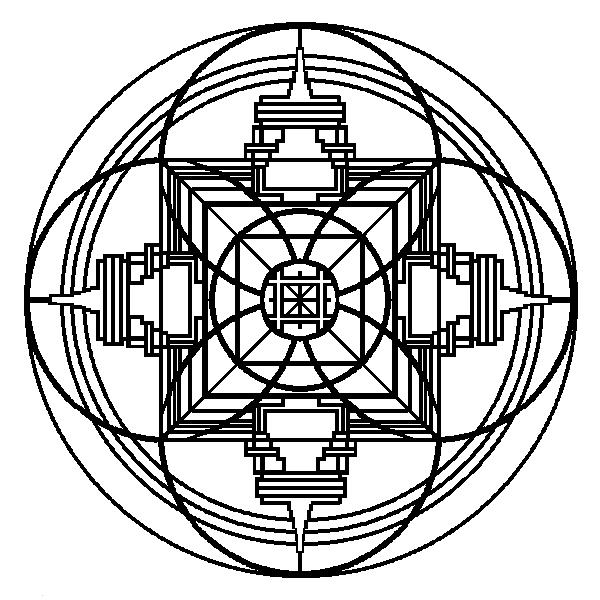
MANDALA
Spend a little time brother contemplating the Mandala above, you just may find the similarities yourself.

Those who have followed my blog know that I strongly believe the Masonic Lodge Room symbolic of Mandala, a Sanskrit word that means "circle". Yes I realize our Lodge Rooms are really rectangle in design, but our rituals are done in a circular fashion, and the center of the Lodge Room is also considered to be the symbolic point within the circle. 
In the Hindu and Buddhist religious traditions their sacred art, shrines, and temples are often mandala in form. At the center of most Hindu and Buddhist mandalas we find a 'square' with four gates containing a circle with a center point, no different than the basic layout of the Masonic Lodge Room.
In the Masonic Lodge Room we find these gates spoken of as north, south, east, and west, similar to the directions used in the Buddhist Mandala. 
Mandalas are constructed from the center outward, beginning with a dot in the center, very much the same way the initiate in Freemasonry begins his journey from the center of the Lodge outward.  
With the placement of the center dot, the Mandala is consecrated to a particular deity. In the case of the Masonic Lodge Room we usually find the Scared Volume of Law at the center symbolic of the deity of one's choice. This center in Buddhism is a symbol. it means a 'seed', 'sperm', 'drop', the salient starting point. It is the gathering center in which the outside energies are drawn and, in the act of drawing the forces, the devotee's own energies unfold and are also drawn. Thus it represents the outer and inner spaces. Its purpose is to remove the object-subject dichotomy (our typical dualistic view of life).
In its creation, a line materializes out of a dot. Other lines are drawn until they intersect, creating triangular geometrical patterns. The outlying square symbolizes the physical world moving in four directions, as we have seen represented by the four gates.

Mandalas are seen as sacred places that reminds us of the presence of sanctity in the universe and their own potential. In the context of Buddhism, the purpose of a Mandala is to put an end to human suffering, to attain enlightenment and to attain a correct view of Reality. It is a means to discover divinity by the realization that it resides within one's own self, no different than the goal of the initiate in Freemasonry.
If you would like to see a little more comparison between the mandala and the Masonic Lodge Room check out my previous blog 'Welcome to the Mandala of Freemasonry'.

Monday, December 10, 2012

The Zohar & Freemasonry - A Connection?


What you have in front of you is a chain of transmission, one rarely spoken of in the history of Freemasonry, one I believe should be looked at closely by those brothers that are in the process of investigating the underlying philosophy and purpose of Masonic thought.
It is the author's personal belief that the Freemasonry we have today may be a byproduct of the events we are about to explore, with much of its esoteric symbolism borrowed from the ideas of the cast and characters you are about to encounter, names that time is beginning to forget.
I assure you that what you are about to read is nonfiction, facts that any individual should be able to validate with a little research. Although many of the individuals you are about to meet are rarely discussed in today's history classes, just a few centuries ago these individuals were giants.

Now the story.

Christian Knorr von Rosenroth's intentions may have been honorable but those in power would see to it that what was contained within the book would be suppressed, even if those that were doing the suppressing knew nothing of the subject. All they knew was that the content of the book were rumored to be dangerous, an affront against commonly held christian beliefs.
Although the wrath of the Parliament would leave the translator unscathed, the circle of thinkers that assisted and advised him in his work would not escape the closed minds of a State that was still controlled by a ignorant religious majority.
Little did Parliament foresee that because of the actions they were about to set in motion ramifications would ripple through the very fabric of time, one of these waves surfacing a century later causing the Masonic Founding Fathers across the pond in America to make sure State did not have to answer to religion, ever, while respecting the religion of one's choice, not something the Church of England or the Mother church at the time of this story would of even considered.
A more immediate result of Parliament's action I believe would be the creation of the largest secret society the world was to ever see, a tradition your neighbor is possibly a member of, but because of a strange twist of that very same fabric of time has no idea it's hidden purpose or message.
It's purpose will be revealed, but first we need to look back to a time when a rare minority dared to venture into the mystery.
Meet Christian Knorr von Rosenroth, born July 15,1636, a German Hebraist, a specialist in Hebrew and Hebraic studies, a specialty that would assist him in translating the mysterious text that he was about to introduce to the West, with the help of some of the biggest names of the Enlightenment.
He was born at Alt-Raudten, today Stara Rudna, a village in the administrative district of Gmina Rudna, in Lower Silesian Voivodeship, in south-western Poland, not an area most today would be familiar with.
Christian was the son of a protestant minister, Abraham Benedikt von Rosenroth, a gentleman who raised his family in the German speaking section of Poland, also the home of Jakob Böhme, the mystic who would deeply influence much of the path Christian would take and subsequently influence everything you are about to read.
Although Knorr's father had never intended his son pursue a path into the what some would labeled the mysteries, but he did.
Yet before the spiritual bug bit, Christian, with the encouragement of his father entered the Latin school in Fraustadt in 1648 and in 1652 enrolled in the Paedagogium at Stettin where he studied theology, law, history, philosophy and both classical and modern languages, all subjects that would guarantee him a position in the court as his father wished.
In continuance of his education he enrolled at the University of Leipzig where he earned a baccalaureate in 1659 and a Masters degree in 1660, presenting his thesis on ancient numismatics. The same year he became a member of the Collegium Anthologicum, a learned society formed from the three higher faculties, which explored theology, philosophy, antiquities, history and science. It was during this time Christian would discover the highly esoteric work of Jakob Böhme, the mystic shoemaker of Görlitz.
As for what he would learn about Jakob Böhme and how it would influence Christian's path; it was rumored that Böhme had a series of mystical experiences throughout his youth, culminating in a vision in 1600 that he claimed to have received through a beam of light. Two of these mystical experiences were described in depth by a visionary two and a half centuries later, Dr. Richard Maurice Bucke(1), the first occurring in Böhme"s twenty fifth year:
"Sitting one day in his room his eyes fell upon a burnished pewter dish, which reflected the sunshine with such marvellous splendor that he fell into an inward ecstasy, and it seemed to him as if he could now look into the principles and deepest foundations of things. He believed that it was only a fancy, and in order to banish it from his mind he went out upon the green. But here he remarked that he gazed into the very heart of things, the very herbs and grass, and that actual nature harmonized with what he had inwardly seen. He said nothing of this to anyone, but praised and thanked God in silence."
He believed this vision revealed to him the spiritual structure of the world, as well as the relationship between good and evil, an issue that he would eventually address in future writings. "For it cannot be said of God that He is this or that, evil or good, or that He has distinctions in Himself. For He has no tendency to anything, for there is nothing before Him to which He could tend, neither evil nor good. ... There is no quality or pain in Him ... [He] is a single will in which the world and the whole creation lies. ... He is neither light nor darkness, neither love nor wrath, but the Eternal One." You can only sense the ire the all controlling church would of felt of Böhme's definition of God.
Here we find in Böhme's description of God a type of Pantheism(2) where God is an eternal unity; an eternal nothing; an abyss without time or space. He needs no habitation, for he is without and within the world equally alike; eternal nature the All of the universe. He fills all things, and is in all things. 'The being of God is like a wheel in which many wheels are made one in another, upwards, downwards, crossways, and yet continually all of them turn together.' The whole of nature; heaven, earth and above the heavens is the body of God. The powers of the stars are the fountain veins in this natural body, which is the world or universe. Böhme's description of God very much parallels descriptions used by Eastern philosophers, minus the word God or gender references.
Surely Böhme knew better than to speak aloud such thoughts on deity remembering the burning of Giordano Bruno because of his unorthodox beliefs, including the idea that the universe was infinite.
For the time being, he chose not to not speak of this experience.
Ten years later Böhme has his second experience, one that causes Böhme to rethink his silence:
"The gate was opened to me that in one quarter of an hour I saw and knew more than if I had been many years together at a university...For I saw and knew the being of all beings...I saw in myself all the three worlds, namely the divine...the dark...and the external and visible world..And I saw and knew the whole working essence, in the evil and the good and the original and the existence of each of them..."

It was after this mystical experience Böhme began writing his first treatise, Aurora.
Aurora was circulated in manuscript form until a copy fell into the hands of Gregorious Richter, the chief pastor of Görlitz, an ill mannered, intolerant and jealous Soul. He despised Böhme on one hand and feared the shoemaker on the other.
The manuscript being circulated ruffled him into a self-righteous passion, and hurrying to the City Council he demanded that Böhme be banished. The Council was afraid to refuse, Böhme the humble shoemaker was exiled from his native town.
With a guilty conscious the Council reconvened the next day, what a difference a night shame can make, it's members realizing they had banished a citizen of such good report, and one, who regularly attended church, recalled him at once on condition that he should write no more.
The attention thrown in the direction of Böhme was not without consequence, in the following year he changed his occupation, the attention of his controversial writings caused his business to decline, having sold the shop he journeyed to the larger cities selling woolen gloves.
But after a while it was no longer possible for him to disobey the inner command that he should give to men his revelations, and in the last ten years of his life he willfully disobeyed the old Council's censorship.
In this short period, Böhme produced an enormous amount of writing, including his major works De Signatura Rerum, The Signature of All Things, and Misterium Magnum (Latin for The Great Mystery).
Allow me to share a little paragraph taken from The Signature of All Things, a paragraph that should resonate with the initiates of the mysteries school spoken of earlier, which Böhme himself may of had an indirect influence in its creation; "There was a poor soul that had wandered out of paradise, and come into the kingdom of this world; where the devil met with it, and said to it, "Whither dost thou go, thou soul that art half blind?" Initiates are routinely blindfolded, symbolic of our condition of ignorance.
It was during this time Böhme attracted a following throughout Europe, where his followers were known as Behmenists. One of Jacob's close associates was a traveling doctor named Balthasar Walther, a Paracelsian(3), Kabbalist, Weigelian(4), religious heretic, and distributor of magical manuscripts, whose personal networks extended across Europe and beyond. There can no doubt Walther influenced some of Böhme's Christianized Kabbalah. In 1598-1599, Walther undertook a pilgrimage to the Holy Land in order to learn about the intricacies of the Kabbalah from groups in Safed(5), surely Dr. Walther spoke of his findings to Böhme.
With the publication of Böhme's first printed book, "Way to Christ", caused another scandal.
The chief concern of Böhme's writing was the nature of sin, evil, and redemption. Böhme preached that humanity had fallen from a state of divine grace to a state of sin and suffering, that the forces of evil included fallen angels who had rebelled against God, and that God's goal was to restore the world to a state of grace.
Where Böhme appeared to depart from accepted theology was in his description of the Fall as a necessary stage in the evolution of the universe.
It should come as no surprise that Böhme's writing contains both alchemical and Kabbalistic concepts, considering his close relationship with Balthasar Walther.
Böhme describes the absolute nature of God as the abyss, the nothing and the all, the primordial depths from which the creative will struggles forth to find manifestation and self-consciousness. The Father, who is groundless Will (In the Kabbalah - Keter the first principle is identified with Will), issues forth the Son, who is Love.
In Böhme's cosmology, it was necessary for humanity to depart from God in order for creation to evolve to a new state of redeemed harmony that would be more perfect than the original state of innocence, allowing God to achieve a new self-awareness by interacting with a creation that was both part of, and distinct from, Himself. Thus, free will was the most important gift God gave humanity, allowing us to seek divine grace as a deliberate choice while still allowing us to remain individuals. Böhme saw the incarnation of Christ not as a sacrificial offering to cancel out human sins, but as an offering of love for humanity, showing God's willingness to bear the suffering that had been a necessary aspect of creation. He also believed the incarnation of Christ conveyed the message that a new state of harmony is possible. This was somewhat at odds with the dogma of the Christian church, and his suggestion that God would have been somehow incomplete without the Creation was even more controversial, as was his emphasis on faith and self-awareness rather than strict adherence to dogma or scripture.
Böhme's writing shows the influence of Neoplatonist and alchemical writers such as Paracelsus, while remaining firmly within a Christian tradition.

Böhme spent the last year of his life in exile in Dresden, returning to Görlitz only to die. In a strange twist of fate the son of Böhme's chief antagonist, the pastor primarius of Görlitz Gregorius Richter, edited a collection of extracts from his writings, which were afterwards published complete at Amsterdam in the year 1682. Böhme's full works were first printed in 1730.
Gregorius Richter, driven by jealous conviction would haunt Böhme till the end of his life, eventually he was denounced from the pulpit. "Will ye have the words of Jesus Christ or the words of a shoemaker?", the disgraced prelate asked those that removed him from authority, only to hear from Böhme the humble shoemaker, "Not I, the I that I am, knows these things, but God knows them in me."
Böhme and Richter both died in 1624. No doubt Richter died as he had lived, angry and bitter, especially knowing that his son had become an adherent of Böhme.

The seed had been planted, sadly Christian would not be entering the court system as his father had hoped, his interests lay elsewhere, the esoteric, the often unspoken world of the mystic.
After his time in the Collegium Knorr's interests turned more toward the sciences, alchemy, hermetic literature and the Kabbalah, all subjects Böhme would of felt right at home with.
In 1663 he undertook a three year academic pilgrimage to study in the Netherlands, France and England.
While in Amsterdam he was engaged as an interpreter for an Armenian prince, Christian August, who shared his mystical interests, and at the same time became interested in oriental languages. In Holland he also met Francis Mercury van Helmont, a Flemish alchemist, and Kabbalist, a gentleman that would guide Christian's sojourn to England where he would begin his work under the tutelage of the Cambridge philosopher and theologian Henry More.

Time to Introduce the Book.

In October 1670 Henry More was visited at Cambridge by Francis Mercury van Helmont, an avid student of Jewish Kabbalah. While visiting Henry More asked van Helmont, a doctor, if we would visit fellow philosopher and friend Lady Anne Conway, in hope that he attempt to treat the incessant debilitating headache which had troubled her for many years, and which had defeated every other medical practitioner. As a result of meeting Anne, van Helmont became her resident physician and mentor.
At the same time we find Christian Knorr von Rosenroth begining to translate the mystical book of the Jews, known as the Zohar, the Book of the Concealed Mystery, into Latin, no easy task and one that would require the assistance More, the Viscountess Anne Conway, van Helmont, and their close associates.
As for what was the history of this mysterious text?
History tells us it was in the Tannaic period,100 BCE to 200 CE, that the Zohar, the most famous text of Kabbalah, was committed to writing by Rabbi Shimon Bar Yochai.
The rabbi lived in a perilous time, a time when the Roman government was executing all the great Torah teachers. Because of this he himself had to flee Roman persecution and hid in a cave with his son, Rabbi Elazar, for thirteen years. During this time, he was said to receive Divine Inspiration and merited the revelation of Elijah the Prophet and composed the sacred Zohar.
To protect the secrets of the universe that were revealed to him, Rav Shimon called upon one student, Rav Abba, to commit his teachings to written word. Rav Abba had an extraordinary gift for writing in the abstract language of metaphor and parable. Thus, the secrets would be safe, deftly concealed inside abstruse stories, making it difficult for the wicked and unworthy to grasp and misuse this ancient power and the Zohar (the intuitive Freemason should be able to see the similarities, in Freemasonry it's esoteric philosophy is concealed within allegory and symbolism).
By a weird twist of fate the Zohar disappeared for centuries when in the year 1270 C.E. the Zohar reappeared, discovered by Rav Moses Deleon in Spain. Moses De Leon is credited as making Zohar booklets for distribution for certain circles.
As for the Kabbalist writer who penned the manuscripts Christian was about to translate, meet Rav Isaac Luria, the most influential Kabbalist in history.
Rav Isaac Luria was considered a brilliant scholar by age 13, he was called "The Ari," which means "The Holy Lion." The Ari had the gift to explore the innermost depths of the Zohar, which he did living as a hermit for 13 years, probing into its mysteries.
History has it that was not unusual for the Ari to meditate upon one verse of the Zohar for many months, until the hidden meaning was revealed to him.
It was the followers of Rav Isaac Luria that informed and instructed Balthasar Walther in the mystical tradition of the Zohar.

 It didn't take long for a circle of the curious to form around Christian and his copy of the Zohar. The circle now consisted of Henry More the philosopher, Viscountess Anne Conway the philosopher, Francis Mercury van Helmont the alchemist, John Locke the philosopher and Freemason, Hon. Robert Boyle philosopher and chemist, and none other than the great Sir Isaac Newton himself.
Yet the Pre-Enlightenment attempt to bring Kabbalism out of its primarily Jewish domain was about to end with disaster.
The Viscountess Conway so excited with the revelations put forth in the book she penned a treatise, "Principles of the Most Ancient and Modern Philosophy", which is saturated with Kabbalistic ideas.
It is essentially a monistic system in which all things are made of "spirit", and she criticizes during the course of it not only the materialism of Hobbes and Spinoza, but also the dualism of Descartes, the dominant and accepted philosophy of the time. According to Conway, there is only one substance in created reality. This substance contains both matter and spirit. A purely material or spiritual substance is, she argues, an impossibility.
Parliament wasn't happy, and it made it's displeasure known.
Conway's treatise was branded heresy by the college that “claimed” her, Cambridge, and effectively condemned her work "Indexed as Prohibited". The philosophical career of Viscountess Conway was for all intent and purpose over.
The Viscountess was not about to go down easy, Van Helmont who had become interested in Quakerism introduced Anne to a number of leading Quakers, including George Fox, Robert Barclay, George Keith, and William Penn (Freemason). Evidently the Quakers favoured the Kabbalah and Anne. The Viscountess in a bold and very public move converted to Quakerism. In England at that time the Quakers were generally disliked and feared, and suffered persecution and even imprisonment. Conway's decision to convert, to make her house a centre for Quaker activity, and to proselytize actively was thus particularly bold and courageous.
Fueled by fear the Parliament summoned Locke and Newton to appear before them and charged two of the giants of the Enlightenment with heresy, largely because they refused to take Christian vows, but also because of their known association with Viscountess Conway, who's heretical Kabbalist treatise was published in London the previous year.
The issue in front of Parliament became Newton and Locke's non-trinitarianism, which rejects the Christian doctrine of the Trinity, namely, the teaching that God is three distinct apostasies or persons and yet co-eternal, co-equal, and indivisibly united in one essence.
Locke escaped punishment by penning "The Reasonableness of Christianity, as Delivered in the Scriptures”, yet what was strangely missing from this text was any reference to the Holy Trinity, one of the hotbed issues that also brought Locke and Newton in front of Parliament.
Newton was embarrassed by the charges on him, abdicated his Lucasian Chair at Cambridge as well as resigning his position as accountant to Parliament, also in order to protect his reputation among scholars. The heresy charges on Newton were dropped about the time of Conway's formal prohibition, which made one of the key pieces of evidence against him inadmissible in court. Clearly, the world outside Judaism was not ready for Kabbalism in the 17th century, or maybe it would be better pursued in secrecy, away from the prying eyes religiously controlled government.

What better way to one up 'big brother' than to create a mystery school exposing a select few to a centuries old philosophy free from imposed dogma and ignorance, with its truths hidden within allegory and symbolism.

Did Christian Knorr von Rosenroth's translation of the Zohar, named Kabbala Denudata, influence the design of Freemasonry? That can only be answered once one delves into the esoteric symbolism contained within Freemasonry.

It is the author's contention that many of the modern Freemasons of the early seventeen hundreds were members of Newton's inner circle, individuals that refused to bow to a church with a judgmental God that made no sense.

Many suspect that Newton was so strongly influenced by Kabbalism that his theory of the mutual property of gravitation may well have been derived from Zohar. He spent the last three decades of his life in relative seclusion in order to try to solve hidden codes and messages in the Bible, suggested by his reading of von Rosenroth's translation.

The concept of separating church and state is often credited to the writings of English philosopher John Locke. According to his principle of the social contract, Locke argued that the government lacked authority in the realm of individual conscience, as this was something rational people could not cede to the government for it or others to control. For Locke, this created a natural right in the liberty of conscience, which he argued must therefore remain protected from any government authority. These views on religious tolerance and the importance of individual conscience, along with his social contract, became particularly influential in the American colonies and the drafting of the United States Constitution. Could it be because of Parliaments action against him and Newton that Locke envisioned a state separate from church? I believe so.
Even the great mathematician and philosopher Leibniz, who invented calculus and, in turn, those tiresome math classes we endured in high school and college, was profoundly influenced by Kabbalah.
Maybe, just maybe, of one looks closely the Kabbalah of Freemasonry may reveal itself.
As for Henry More...we rarely here his name.

Footnotes

Chapter One

(1) Cosmic Consciousness, by Richard Maurice Bucke, [1901], Chapter 10, Jacob Behmen (called The Teutonic Theosopher).

(2) Pantheism is a word derived from the Greek roots pan (meaning "all") and theos (meaning "God"). It is the belief that everything composes an all-encompassing, immanent God, or that the Universe (or Nature) is identical with divinity.

(3) A movement that followed the works of Auroleus Phillipus Theostratus Bombastus von Hohenheim, immortalized as "Paracelsus," was born in 1493. He was a German-Swiss Renaissance physician, botanist, alchemist, astrologer, and occultist.

(4) Weigelians were a small group of individuals that promoted the ideas of Valentin Weigel (1553-1588), a mystical writer who drew upon Paracelsus and his alchemical ideas. His ideas influenced Jacob Boehme, and other German Protestant mystics of the 17th century. Most of his writings were published after his death, when a small group of Weigelians promoted his ideas, and some texts were issued in his name, pseudonymously.

(5) Safed is a city in the Northern District of Israel. Safed has been considered one of Judaism's Four Holy Cities, along with Jerusalem, Hebron and Tiberias, and since that time, the city has remained a center of Kabbalah.